Thanks to our close ties with the rock mechanics laboratory and field measurements, we can obtain location-specific input parameters for our models, such as strength and creep rates, and adapt them to real-world behavior. The models are thus able to provide reliable predictions even for complex mining situations, for example, regarding strength and creep behavior under a wide range of stress and temperature conditions as well as under cyclic loading.


VPIII_WIPP_Festigkeit.jpeg


 VPIII_WIPP_Dilatanz.jpeg

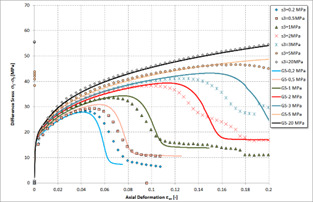
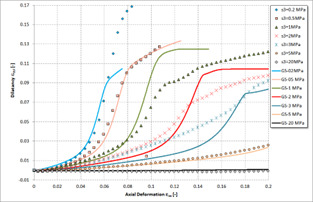
The images show, as an example, the recalculation of seven triaxial strength tests using the extended strain hardening approach (IfG-GS) and a uniform set of parameters. Left: strength, right: dilatancy, each as a function of axial deformation.
From Hampel et al. (2016).

16.04.2026

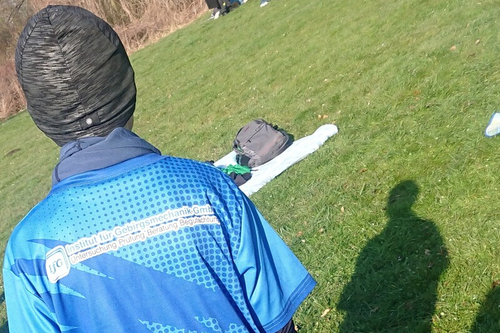
Sponsoring zum Spendenlauf des Fördervereins des Wilhelm-Ostwald-Gymnasiums in Leipzig 2026

Am 02.04.2026 fand am Wilhelm-Ostwald-Gymnasium in Leipzig der Spendenlauf des Fördervereins der Schule statt. Das IfG nutzte die Möglichkeit und beteiligte sich mit einem Sponsoring.

Read More …

15.04.2026

Wir unterstützen die KSW IceFighters Leipzig

Das IfG unterstützt ab der Saison 2026/2027 die KSW IceFighters Leipzig als Sponsor im Rahmen des regionalen Club-Netzwerks BUSINESS HELDEN.

Read More …

Banner der Icefighter Business Helden
24.03.2026

Advanced training "Salt chemistry and THEREDA" at the TU Bergakademie Freiberg

From 16 to 20 March 2026, colleagues from the Institut für Gebirgsmechanik attended an advanced training course at the TU Bergakademie Freiberg on the topic of ‘Salt Chemistry and THEREDA’. The course covered the fundamentals of salt chemistry as they apply to the oceanic salt system.

Read More …

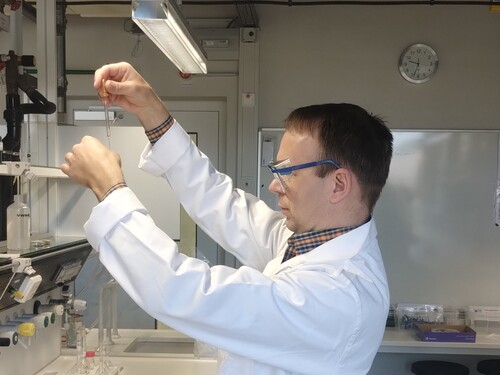
Dr. Johannes Kupper performing experiments